
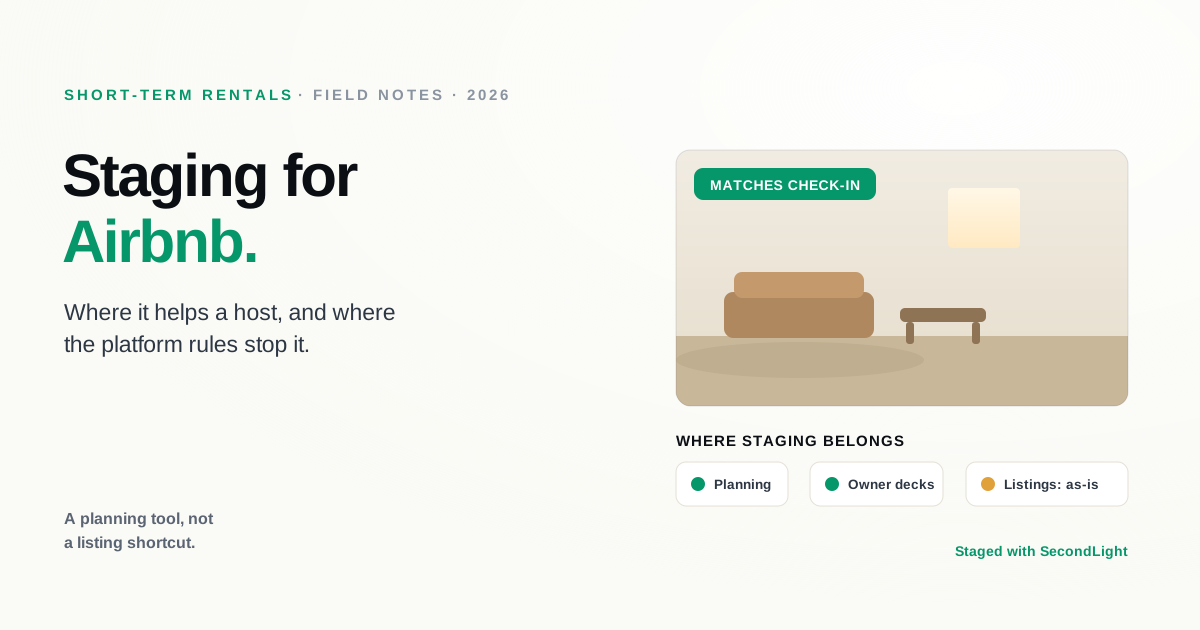
Short-term rental hosts ask about virtual staging for the same reason listing agents do. An empty room photographs badly, furniture is expensive, and a staged photo gets more attention than a bare one. The difference is that short-term rental platforms hold listing photos to a standard that real estate does not, and it changes the answer. Here is what the rules actually say, what they rule out, and where virtual staging still earns its place in a short-term rental business.
The rule that decides everything
Airbnb's ground rules for hosts are direct about this. The photos and description on the listing page should accurately represent the space provided, and Airbnb states it will ask hosts to remove content "if AI or other digital technology has been used to edit flaws, hide damage, add amenities or attributes that are not part of a listing, or otherwise misrepresent the listing." Airbnb can also ask a host to re-shoot the space in person through the app to confirm photo accuracy, and repeated or severe violations can get a listing suspended or removed.
That is a stricter test than the one real estate works under. A listing agent can virtually stage an empty room as long as it is labeled as virtually staged, because the buyer will walk the house before they buy it. A guest books on the photos and finds out at check-in. So the working rule for a live short-term rental listing is simple:
The photo has to match what the guest finds at check-in. If a guest could arrive and say "the furniture in the photo is not here," the photo should not be on the listing.
Policies vary by platform and they change, so check your own platform's current terms. As of July 2026, Airbnb's wording above is the clearest statement of the standard, and Vrbo and Booking.com hold a similar accuracy line.
What that rules out
Four things, whatever tool you use:
- Furnishing an empty unit that is taking bookings. If the guest will arrive to an empty room, a furnished photo is a misrepresentation, no matter how good it looks or whether you caption it.
- Editing out damage or wear. A scuffed wall, a stained carpet, or a cracked tile stays in the photo. This is the "edit flaws, hide damage" clause verbatim.
- Adding amenities that do not exist. A hot tub, a fire pit, a workspace, a crib. Amenities are the most-filtered attribute on every booking platform, so this is also the fastest route to a refund request.
- Faking the view or the light. Twilight conversion and sky replacement are normal in real estate, and they are a judgment call here at best. Turning a grey afternoon into a golden sunset over a view the property does not have is the same misrepresentation as adding a hot tub. If you would not be comfortable with the guest seeing the original next to it, do not publish it.
Where virtual staging still fits
The rules constrain guest-facing photos of a live listing. They say nothing about the rest of the business, and that is where most of the value is anyway.
Deciding how to furnish before you spend the money. This is the strongest use by a distance. Furnishing a short-term rental runs into five figures fast, and the layout decisions are hard to reverse once the sofa is delivered. Staging the empty unit in three or four different styles costs a few dollars and settles the argument about whether the sectional fits, whether the dining table should seat six or eight, and which look suits the market you are targeting. Nobody sees these images but you and whoever is helping you furnish it.
Pitching an owner on converting a property. If you manage short-term rentals for other people, the pitch is always the same problem: the owner is looking at an empty unit and cannot picture it earning. A staged set of the actual rooms, clearly presented as a proposal rather than a listing, does that job. Label it as a visualization in the deck and there is no ambiguity about what it is.
Selling or buying the property. The moment the property goes on the market it is a real estate listing, and normal virtual staging practice applies: stage it, label it as virtually staged, do not touch the structure. If you are buying a vacant property to convert, staging the listing photos yourself is a fast way to test whether the layout supports the guest count you have in mind.
Removing things that genuinely will not be there. Decluttering sits on the honest side of the line when the item is leaving. The owner's closet contents, personal photos, a pile of mail, the bin you keep in the corner between guests. Removing those makes the photo more accurate, not less, because none of it will be there at check-in. Removing a chair that stays in the room does not. Our decluttering guide covers the mechanics, and the judgment call is always the same: will the guest find it there or not.
Long-term rentals are a different question. If you also run unfurnished long-term rentals, the platform constraint above does not apply in the same way, though state law and honest-advertising rules still do. That is covered in virtual staging for property managers.
Quick reference
| Use | On a live listing? | Why |
|---|---|---|
| Furnishing an empty unit that takes bookings | No | Guest arrives to a different space |
| Hiding damage, wear, or a flaw | No | Explicitly named in Airbnb's ground rules |
| Adding an amenity the property lacks | No | Misrepresents a filterable attribute |
| Fake sunset, added view | No | Misrepresents light and location |
| Removing personal items that leave before check-in | Yes, with care | Photo becomes more accurate, not less |
| Planning your furniture buy | Not published | Internal tool, never guest-facing |
| Owner pitch decks | Not published | Presented as a proposal |
| Selling the property | Yes, labeled | Standard real estate disclosure applies |
What to do for the live listing instead
Once the unit is furnished, the photos are a photography problem, not an editing one. The things that move booking rates are unglamorous: shoot in daylight with the lights on, shoot from corners at chest height so rooms read at their true size, make the bed properly, get the whole bed in frame, and lead with the room that makes the property distinctive rather than the front door. Our guide to photographing rooms covers the camera side, and most of it transfers directly.
If your unit is genuinely empty right now and you want it live, furnish it first or pause the listing. There is no editing shortcut that survives a guest walking through the door.
The bottom line
For short-term rentals, virtual staging is a planning and acquisition tool, not a listing tool. Use it to decide how to furnish a unit, to pitch owners, and to market the property when you sell it. Keep the guest-facing photos as an honest record of what the guest will find, because that is what the platforms require and what your reviews will reflect anyway.
SecondLight stages an empty room in nine styles in seconds, which makes it a cheap way to test a furnishing plan before you commit to it. Try it on a photo of your unit and see the options side by side.
About
Written by SecondLight Team. Issue Nº 024 of Field Notes.
Read next
Back to archive
All Field Notes