
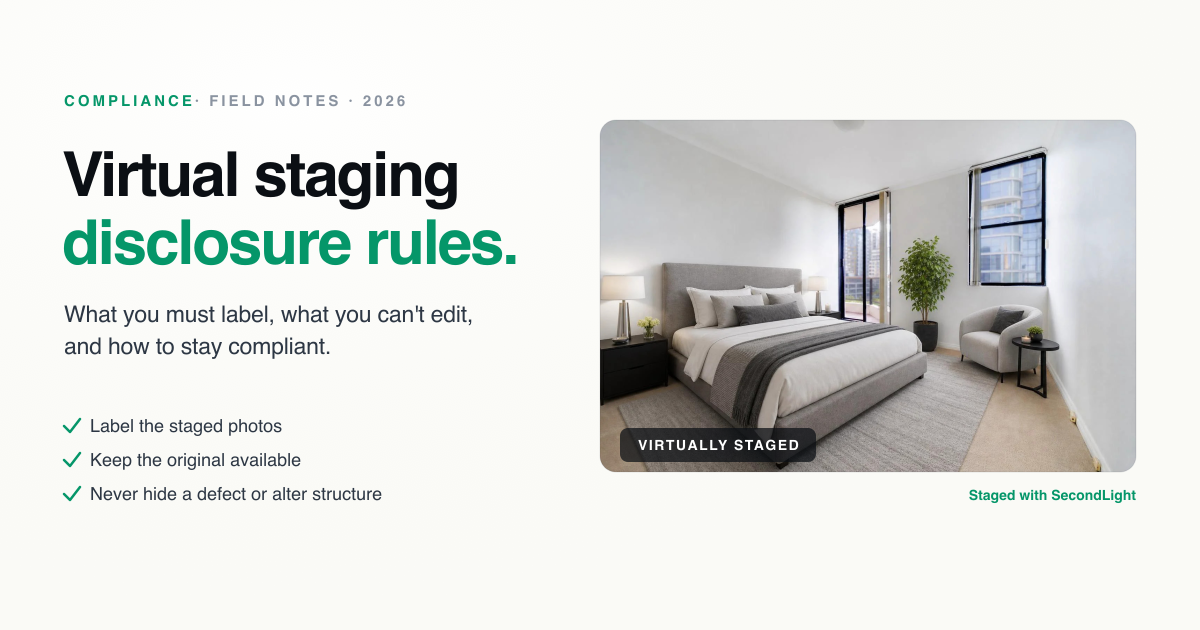
Virtual staging is legal, widely used, and expected on modern listings. What it is not is a free pass to alter a property however you like. The rule that governs it is simple in principle: a listing has to present a true picture of the home, and anything you change in a photo has to be disclosed. This guide covers what disclosure actually requires, what you can and cannot edit, and how to stay compliant without slowing down your listings.
This is general guidance, not legal advice. MLS rules and state laws vary, so treat your local MLS policy and state regulator as the final word.
Why disclosure matters
Two forces make disclosure non-negotiable. The first is professional ethics. NAR's Code of Ethics requires REALTORS to present a true picture in their advertising and marketing, including images, and prohibits misleading the public with manipulated visuals. NAR's guidance on virtual staging follows directly from that: virtually staged photos should be clearly labeled, and the original unaltered photo should be available for buyers to see.
The second is trust, which is really self-interest. A buyer who feels misled at the showing is a buyer you have lost, plus the reputational cost that follows. Disclosure protects the deal as much as it protects you.
What you can and can't edit
The line is easier to hold than it looks. Virtual staging is meant to help a buyer imagine living in the space, not to misrepresent what the space is.
Generally fine: adding furniture, rugs, art, and decor to an empty or sparse room. Changing a decor style. Removing clutter or the current owner's belongings so the room reads clean. These change how the room is dressed, not what it is.
Not okay: anything that alters the property's actual condition or structure. Removing or hiding defects like water stains, cracks, or damage. Editing out power lines, a neighboring building, or a busy road. Changing the apparent size of a room, adding square footage, or implying features (a fireplace, a view, an appliance) that aren't there. If the edit would surprise a buyer standing in the room, it's over the line.
This is also why the structural quality of your staging tool matters. If a weak AI model warps walls or changes a room's proportions while adding furniture, it can misrepresent the property even when you never intended to, which is a compliance problem as much as a quality one.
How to disclose it properly
Three habits keep you clean:
- Label the staged photos. Mark virtually staged images clearly, either with a caption or a visible on-image label such as "Virtually staged." Don't bury it.
- Keep the original available. Provide the unaltered photo of each staged room so buyers can compare. Many MLSs expect the real, empty version alongside the staged one.
- Note it in the listing. A short line in the listing remarks ("Photos of the living room and primary bedroom are virtually staged") removes any ambiguity.
MLS and state variation
There is no single national rule, and this is where you have to do local homework. Individual MLSs set their own policies on how virtually staged photos must be marked, and some are stricter than others about labeling and keeping originals on file. A number of states have moved toward explicit disclosure expectations for digitally altered listing photos as AI staging has become common. Before you rely on a particular practice, check your MLS's photo policy and your state real estate commission's guidance. When the local rule is unclear, disclose anyway. Over-disclosing has never cost anyone a deal.
A quick compliance checklist
Before a staged listing goes live:
- Every virtually staged photo is labeled as such.
- The unaltered original of each staged room is available to buyers.
- The listing remarks note that photos are virtually staged.
- No edit hides a defect, alters structure, or implies a feature that isn't there.
- The staging preserved the room's real geometry and proportions.
- You've confirmed your MLS's specific photo policy.
The bottom line
Disclosure is not a limitation on virtual staging, it's the thing that keeps it legitimate. Stage the room to help buyers picture living there, label it, keep the original, and never edit away the truth of the property. Do that and virtual staging stays exactly what it should be: one of the highest-leverage, lowest-risk tools on your desk. If you're new to the category, our complete guide to virtual staging covers the rest, and you can try it on a listing whenever you're ready.
About
Written by SecondLight Team. Issue Nº 010 of Field Notes.
Read next
Back to archive
All Field Notes