
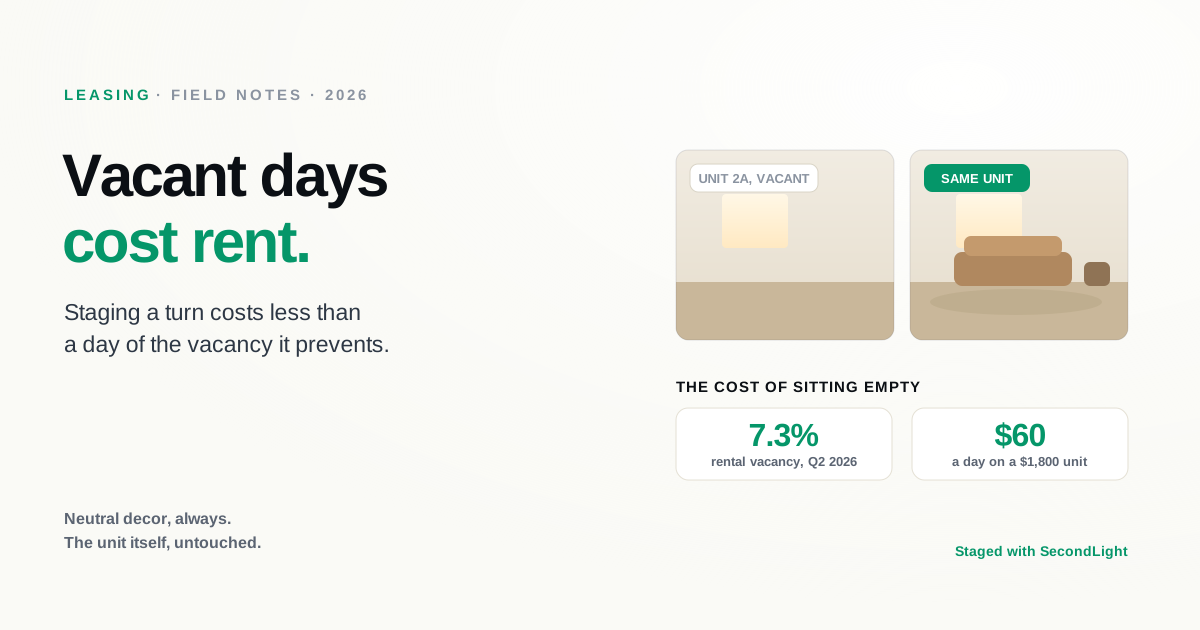
Leasing has a cost of delay that sales does not. A listing that sits for an extra week is an annoyance; a unit that sits for an extra week is rent you never collect. That is the whole case for putting more effort into rental listing photos than most portfolios currently do, and it is why staging, long treated as a for-sale tactic, has moved into leasing.
The math is unforgiving
Vacancy is not a rounding error right now. The Census Bureau's Housing Vacancy Survey, released on 28 July 2026, puts the national rental vacancy rate at 7.3% for the second quarter of 2026, against 7.0% a year earlier. Local conditions diverge wildly from that average, but the direction of travel is that renters have choices.
The arithmetic per unit is simple and worth doing explicitly. On a unit renting at $1,800 a month, every vacant day costs about $60. A week of extra vacancy is roughly $420. Across a 200-unit portfolio turning 40% of units a year, shaving even three days off average time to lease is real money. Set against that, staging a photo set costs a few dollars per unit.
That is the frame leasing teams should evaluate this in. Not "does a staged photo look nicer," but "what does a day of vacancy cost, and what moves it."
Why vacant unit photos underperform
Rental listings have a specific version of the empty room problem:
- Renters misjudge scale. An empty 11 by 13 bedroom and an empty 9 by 10 bedroom look identical in a phone-sized thumbnail. Renters assume small, and small loses the click.
- Every unit in the building looks the same. A portfolio of one-bedrooms photographed empty produces a listing set with no distinguishing features. Nothing tells a renter why 4B is worth more than 2A.
- Awkward layouts go unexplained. A long narrow living room, a dining nook with no obvious use, a bedroom with a door in a bad place. Furniture answers the question the empty room raises.
- The listing loses to the building down the street that shot its model unit furnished.
Staging solves the same problem here that it solves in sales, which is helping people picture the space in use. The difference is volume: a leasing team is doing this across dozens of units a year, not one house at a time.
Where it fits in a leasing operation
Vacant unit turns. The core case. Photograph the unit once it is clean and repaired, stage the photo set, and list. It costs a fraction of a day of the vacancy it is trying to prevent.
Lease-ups. A new building leasing from floor plans has the same problem new construction has: nothing is built out except the model. Staging the completed unit types gives every floor plan marketing rather than only the one you furnished.
One model unit, every floor plan. Most communities furnish one unit. Staging the photos of the rest gets the model treatment across the whole plan mix without a second furniture install.
Occupied units listed before turnover. This one needs care. If you are photographing a unit while the current tenant is still in it, decluttering the photo to remove personal belongings is reasonable, because those items are leaving. Presenting the outgoing tenant's furniture as though it comes with the unit is not.
Corporate and furnished rentals. If the unit genuinely comes furnished, the photos must show the actual furniture that will be there. Staging is a planning tool for deciding what to buy, not a substitute for photographing what you bought. The same logic applies more strictly on booking platforms, which we covered in virtual staging for short-term rentals.
The accuracy line for rentals
Leasing does not sit under an MLS rulebook, which leads some teams to assume the rules are looser. In practice the exposure is different rather than smaller, because renters routinely apply, and sometimes sign, without seeing the unit in person.
Hold these lines:
- Label staged photos as virtually staged, on the image itself. Portal captions and descriptions get truncated and rewritten as feeds syndicate; a label baked into the pixels does not. The reasoning is in our disclosure rules guide.
- Never change the unit. No removing a column, widening a window, or editing out a radiator, a low ceiling, or the view of the parking structure. Adding furniture is staging; changing the unit is misrepresentation.
- Do not stage away condition problems. Worn flooring and dated cabinets stay in the photo. If the unit is being renovated before move-in, say so in the listing rather than showing a finish that does not exist yet.
- Match the photo to the actual unit type. Using a staged photo of the 12th floor corner unit to advertise a second floor interior unit is the most common accuracy failure in leasing, and it predates AI by decades.
A fair housing note
This is specific to rental advertising and it is worth being deliberate about. The Fair Housing Act prohibits advertising that indicates a preference, limitation, or discrimination based on a protected class, and HUD's guidance is explicit that photographs and illustrations count as advertising, not just words. Protected classes under the federal act are race, color, religion, sex, national origin, disability, and familial status, and many states and cities add more.
Applied to staging, the practical guidance is to keep it neutral: no religious symbols or iconography in the decor, no staging choices that signal the unit is meant for a particular group, and no people in the images. Generic, tasteful furniture is both the better marketing choice and the safer one. If your portfolio operates under an affirmative marketing plan, run staged imagery through the same review as the rest of your advertising, and take compliance questions to your own counsel rather than a blog post.
Making it work at portfolio scale
Single listings are easy. The operational discipline is what makes this work across hundreds of units.
- Standardize the shoot. Same rooms, same angles, same order, every turn. Level camera at chest height, corner angles, lights on. A repeatable shoot list is what makes the rest repeatable.
- Set a style per property, not per unit. One property should look like one property. Mixed styles across units in the same building read as inconsistent to anyone comparing listings side by side.
- Stage the rooms that decide the lease. Living room and primary bedroom first, then the second bedroom. Empty closets, laundry rooms, and corridors do not need furniture.
- Batch the turn. Running the whole unit's photo set in one pass keeps the look consistent and turns the listing around the same day the unit is ready.
- Keep the originals. Store the unstaged photo alongside the staged one. If a prospect or a regulator asks what the unit actually looks like, you want that on hand in seconds.
- Re-shoot after real renovations. A staged photo of the pre-renovation unit undersells a renovated one, and a staged photo of a renovated unit misrepresents one that has not been touched yet.
The bottom line
For leasing teams the case is a cost-of-vacancy case, not an aesthetics case. Vacant units photograph poorly, renters underestimate empty rooms, and a staged photo set costs less than a day of the vacancy it prevents. Stage the rooms that decide the lease, keep the unit itself untouched, label every staged image, and keep the decor neutral for fair housing reasons as much as marketing ones.
SecondLight stages a full unit in one pass, keeps the architecture exactly as photographed, and can stamp the disclosure label straight onto the image. Try it on your next turn.
About
Written by SecondLight Team. Issue Nº 023 of Field Notes.
Read next
Back to archive
All Field Notes