
This is a reference roundup of the home staging statistics worth knowing in 2026, grouped by what each number actually tells you and sourced so you can cite them. Most figures come from the National Association of Realtors' 2025 Profile of Home Staging, with current market pricing from independent cost trackers. If you want these numbers assembled into an argument for staging, read our companion piece on virtual staging ROI. All statistics are current as of mid-2026 and can shift as new reports land.
The headline numbers
| Statistic | Figure | Source |
|---|---|---|
| Buyers' agents who say staging helps buyers envision the home | 83% | NAR 2025 |
| Sellers' agents seeing a 1-10% rise in offer value | 29% | NAR 2025 |
| Sellers' agents seeing reduced time on market | 49% | NAR 2025 |
| Most important room to buyers | Living room (37%) | NAR 2025 |
| Median professional staging cost | $1,500 | NAR 2025 |
| Whole-home physical staging, first month | $1,500-$4,000 | HomeGuide 2026 |
| Typical virtual staging cost | ~$16-$75 per photo | Industry, 2026 |
Does staging work? Agent perceptions
- 83% of buyers' agents said staging made it easier for buyers to visualize the property as their future home.
- 60% of buyers' agents said staging affected at least some buyers' view of a home, and 26% said it affected most buyers.
- 12% said staging had no measurable effect on buyer perception, a useful reminder that staging supports a good listing rather than rescuing a bad one.
Effect on offers and sale price
- 29% of sellers' agents reported staging produced a 1% to 10% increase in offer value.
- 17% of buyers' agents attributed a 1% to 5% value increase to staging.
- On a $500,000 listing, a 1-10% lift is $5,000 to $50,000 in additional offer value, set against a staging cost measured in the hundreds or, virtually, in tens of dollars.
Effect on time on market
- 49% of sellers' agents observed that staging reduced time on market.
- 19% described the reduction as significant; 30% saw a slight reduction.
- Fewer days on market means lower carrying costs and less price-cut pressure on a listing that would otherwise sit.
Which rooms matter most
Two different rankings are worth separating: the rooms buyers care about, and the rooms agents actually stage.
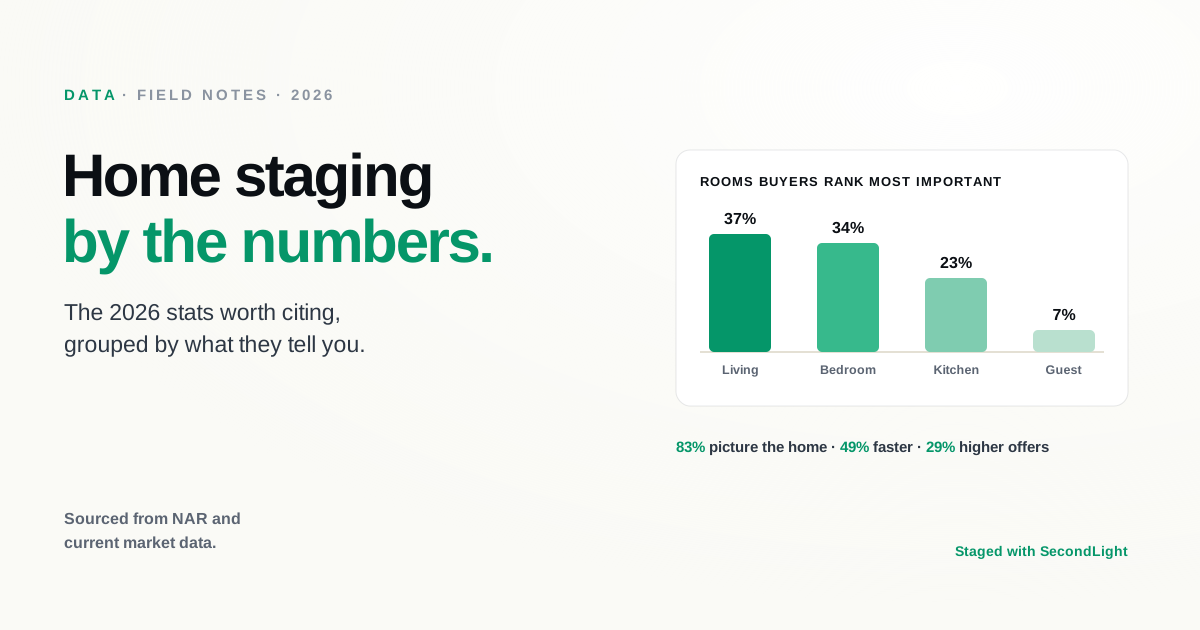
Rooms buyers rank as most important:
- Living room: 37%
- Primary bedroom: 34%
- Kitchen: 23%
- Guest bedroom: 7% (least important)
Rooms sellers' agents most commonly stage:
- Living room: 91%
- Primary bedroom: 83%
- Dining room: 69%
- Kitchen: 68%
If you are staging on a budget, the buyer ranking is your priority order. It is also why a tool needs to handle the primary bedroom and kitchen well, not just the living room, which is where a lot of AI staging quietly falls apart.
What staging costs
Physical staging costs, per 2026 data from HomeGuide and Angi:
- Median professional staging service: $1,500; agent-handled staging median: $500 (NAR).
- Whole-home staging, first month: $1,500 to $4,000.
- Vacant homes needing full furniture rental: $3,000 to $6,000+.
- Per staged room: $300 to $700 a month.
- Each 30-day extension if the home is unsold: +10% to 30% of the original fee.
- Initial consultation alone: $150 to $600.
Virtual staging, by contrast, runs roughly $16 to $75 per photo through professional services and less through AI tools, with no furniture rental and no monthly renewal. See our full cost breakdown and the direct virtual vs. physical comparison.
Virtual staging adoption and market size
- The virtual staging market is estimated at roughly $1.2 to $1.5 billion for 2025-2026, with projected annual growth rates ranging from about 9% to over 20% depending on the research firm and how they scope the market.
- The spread is wide because methodologies differ, but the direction is consistent: staging is shifting from a differentiator to a default expectation, and increasingly a digital one.
Expectations set by TV
- 48% of buyers' agents said buyers expect homes to look the way they do on television staging shows.
- 77% said those shows set unrealistic expectations, which is worth remembering when a seller asks for a look the room cannot support.
What the numbers say
Read together, the data is consistent: staging reliably helps buyers visualize a home, modestly lifts offers, and shortens time on market, and the only real variable is what it costs you to capture that upside. Physical staging captures it at four figures and a week of lead time; virtual staging captures most of it for a fraction of the cost in minutes. For the case built on these figures, see the ROI breakdown, and see pricing whenever you want to run the comparison on your own listing.
Sources
- National Association of Realtors, 2025 Profile of Home Staging
- HomeGuide: How Much Does It Cost to Stage a House? (2026)
- Angi: How Much Does House Staging Cost? (2026)
About
Written by SecondLight Team. Issue Nº 018 of Field Notes.
Read next
Back to archive
All Field Notes