
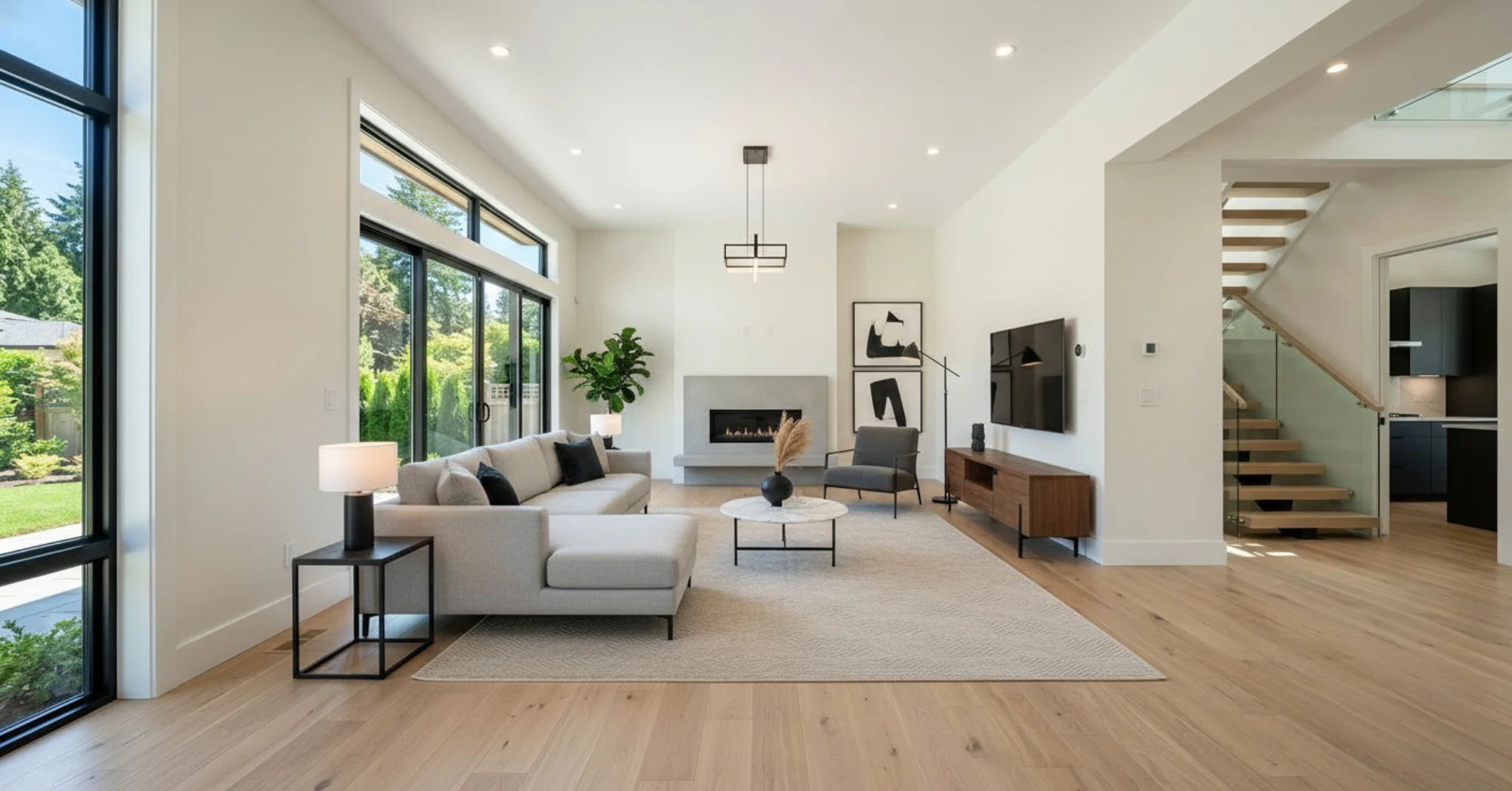
Most arguments for staging lean on gut feel. The numbers are more convincing than the pitch, so here are nine of them, pulled from the National Association of Realtors' 2025 Profile of Home Staging and current market data. Read together, they make the case that staging isn't a nice-to-have anymore, and that the economics have quietly shifted in favor of doing it virtually.
1. 83% of buyers' agents say staging helps buyers picture the home as theirs
This is the headline finding from NAR's 2025 report: a strong majority of buyers' agents said staging a home made it easier for their clients to envision living there. Visualization is the whole job of a listing photo. An empty room asks the buyer to do imaginative work most of them won't do, and a staged one does that work for them.
2. Buyers now view roughly 20 homes online for every 8 they see in person
Buyer behavior has moved online, and the listing photo is doing the work the in-person showing used to. If a room doesn't land in the thumbnail, it often never gets the walkthrough. That shift is exactly why staging every marketed room matters more than it did a decade ago, and why the photo has effectively become the first showing.
3. 29% of sellers' agents saw offers rise 1–10% on staged homes
Nearly a third of sellers' agents in the NAR report attributed a 1% to 10% increase in offer value to staging. On a $500,000 listing, that's $5,000 to $50,000 in additional offer value. Set that against a staging cost measured in tens of dollars per photo and the return isn't close.
4. 49% of agents say staging cut time on market
Almost half of sellers' agents observed that staging reduced days on market, with 19% calling the reduction significant. Fewer days on market means lower carrying costs for the seller, faster commission for the agent, and less price-cut pressure on a listing that's been sitting. Speed compounds: the longer a home lingers, the more buyers assume something's wrong with it.
5. Living room, primary bedroom, and kitchen are the rooms buyers care about most
When NAR asked which rooms matter, buyers ranked the living room first (37%), the primary bedroom second (34%), and the kitchen third (23%). If you're staging on a budget, that's your priority order. It's also a reason to use a tool that handles every room type well rather than one that only does living rooms convincingly, because the primary bedroom and kitchen are where a lot of AI staging quietly falls apart.
6. Virtual staging costs 90–97% less than physical staging
Physical staging typically runs $1,500 to $5,000 per home, and a standard multi-month contract can total north of $7,000 once you add movers, setup, and removal. Virtual staging lands at roughly $16 to $75 per photo through professional services, and far less through AI tools. Same visual payoff, a fraction of the outlay, and nothing to move in or haul back out.
7. Physical staging takes 7–14 days. AI staging takes minutes
Traditional staging isn't just expensive, it's slow: a week or two to schedule, furnish, and shoot. AI-based virtual staging turns that into minutes, which means a listing can go live the day the photos come back instead of the following week. When a seller wants to hit the weekend or a client asks for a different look the night before an open house, that gap is the difference between making the date and missing it.
8. The virtual staging market is worth $1.33 billion and growing double digits
The global virtual staging market is valued around $1.33 billion and growing at a double-digit annual rate. That matters for a simple reason: staging is becoming the default expectation, not the differentiator. Listings that skip it increasingly look like the outliers, and buyers scrolling twenty homes online notice the empty ones.
9. The break-even is essentially immediate
Put the numbers together. If staging lifts offers by even 1% on a $500,000 home, that's $5,000 against a cost of a few dollars a photo. You don't need the full 10% upside, or the faster sale, or the lower carrying costs for the math to work. Any one of them clears the cost many times over, and virtual staging is where that cost is lowest.
What the data is really saying
The through-line across all nine stats is that the value of staging is well established, and the only open question is how much it costs you to capture it. Physical staging captures the upside at $1,500-plus and a week of lead time. Virtual staging captures the same upside for the price of a coffee and a few minutes.
SecondLight is built for that second path: instant turnaround so you never miss a listing date, every room type and style included so you can stage the living room, primary bedroom, and kitchen that buyers actually care about, and revisions that don't cost extra so getting the look right isn't a budget decision. See the pricing page for current numbers, or read our breakdown of what virtual staging actually costs if you want to run the comparison yourself.
About
Written by SecondLight Team. Issue Nº 002 of Field Notes.
Read next
Back to archive
All Field Notes