
If you've started shopping for virtual staging, you've probably noticed the pricing is all over the place. Quotes range from $15 per photo at the budget end to $80 or more at premium services. Then AI tools landed and the numbers got even harder to compare. Some charge per photo, some per credit, some per month. This guide breaks down what you're actually paying for, where hidden costs sneak in, and how to think about the math for your listings. (If you're still weighing whether staging is worth the spend at all, the ROI data makes that case separately; this guide assumes you're sold on staging and shopping for the best deal.)
The three pricing models you'll see
Per-photo flat rate. The traditional model. You pay a fixed fee for each photo, and a human designer stages it manually. Typical range is $25–$80 per image. Turnaround is 24–48 hours, sometimes longer at peak season. This is what most virtual staging shops have charged for the past decade.
Per-credit subscription. The newer SaaS model, used by most AI tools including SecondLight. You buy a monthly or annual subscription that includes a bundle of credits, and each new room staged uses one credit. Revisions, restyles, and density changes are usually free, and only the first staging of a new room costs a credit. This makes the per-photo cost much lower for agents who restyle aggressively or experiment with looks before settling.
Pay-as-you-go. A handful of tools offer one-off credit packs without a subscription. Usually the worst dollar-per-photo deal but useful for occasional users who don't have a steady flow of listings.
What you're actually paying for
The number on the invoice isn't the whole picture. Watch for these hidden costs:
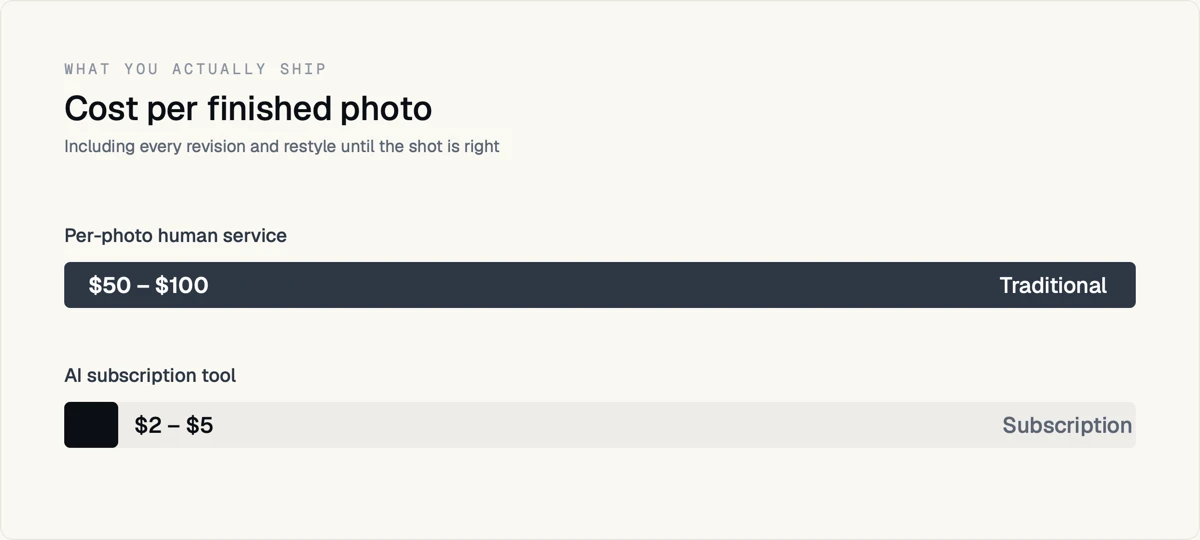
Revisions. With traditional per-photo services, every revision is a separate fee, usually $10–$25 each. If you ask for a chair to be moved or a different style attempted, that's another invoice. The cost of a single "finished" photo with two revisions can easily reach $80–$100. AI tools generally include unlimited revisions in the credit, which is why the headline credit price isn't directly comparable to the per-photo flat rate.
Style limits. Cheaper services often restrict you to two or three pre-baked styles (usually some flavor of Modern and Farmhouse). If your listing needs Mid-Century, Luxury, or Bohemian, you're either out of luck or pay a premium. Tools that include all major styles in the base price are doing you a favor even if the headline number looks higher.
Room-type restrictions. Watch the fine print. Some services charge extra for bathrooms, kitchens, outdoor spaces, or anything they consider "complex." Others bundle them. Multi-room properties add up fast if every kitchen and bathroom is a surcharge.
Volume tiers. Most subscription tools price credit bundles in tiers, and the per-credit cost drops sharply as you go up. An agent doing two listings a month pays much more per photo than one doing twenty. Run the math on your actual volume before you assume the cheapest plan is the right one.
What's a credit worth, really?
With AI tools, the most useful question isn't "how much per photo," it's "how many finished photos do I actually get per credit?" Because revisions are free, one credit typically yields:
- The initial staging
- 3–8 revisions until the look is right (different style, different density, swap furniture)
- Optionally a twilight conversion or other secondary treatments
So one credit might produce 5–10 attempts before you settle on the photo you ship. Compared to a per-photo service where every revision is a separate fee, the effective cost-per-finished-photo on a subscription is dramatically lower, often less than $5 per shipped image, even on the smallest plans.
Hidden costs of the traditional model
A few costs that don't show up in traditional virtual staging quotes:
Turnaround delay. Same-day delivery is rare. Two-day turnaround is standard. If your client is closing in 48 hours, you're paying rush fees or missing the listing date. AI tools deliver in 30 seconds, which removes the schedule risk entirely.
File handoff overhead. Some services charge for high-res downloads or watermark-free output as a separate add-on. Read the quote carefully.
Quality variance. Human staging is only as good as the designer you got assigned that week. AI tools are deterministic: the same input produces consistent quality each time.
How to actually price-compare
When you're shopping, build the comparison on finished photos per dollar, not the headline number. Concretely:
- Estimate your listing volume: how many rooms per month do you stage?
- For each tool, ask: what does one finished photo cost me, including revisions, all the styles I might want, all the room types I shoot?
- Add up the monthly or annual total for your actual volume.
- Add the time cost of waiting for revisions if the service isn't instant.
For most agents and photographers, the math favors AI subscription tools by a significant margin, usually 60–80% cheaper per finished photo, plus instant turnaround. The exception is occasional users with one or two listings a year, where pay-as-you-go credit packs sometimes come out ahead.
What SecondLight charges
SecondLight uses the per-credit subscription model with two plans (Starter and Pro), each starting with a 7-day trial, plus a one-time photo top-up option. The trial asks for a card but isn't charged until day 7, so you can try the tool on a real plan before committing. Starter and Pro both unlock every style and room type, and on both, revisions don't cost a credit. What differs is the monthly credit allowance, the number of revisions allowed per photo, and a few power-user features like batch processing and twilight conversion on Pro.
See the pricing page for current numbers, including the annual discount and intro offer for first-time Pro signups.
The short answer
For a single listing photo from scratch: anywhere from $5 to $80 depending on the model. For a monthly volume of 20+ listing photos with revisions and multiple style explorations: typically $2–$5 per finished photo on a subscription tool, vs $50–$100 on a per-photo human service.
The framing that matters: virtual staging is now cheap enough that it's not the constraint. Your time picking shots and writing copy is. Pick a tool that delivers instantly so staging stops being a bottleneck, and price it on finished photos rather than headline numbers.
About
Written by SecondLight Team. Issue Nº 001 of Field Notes.
Read next
Back to archive
All Field Notes